
God: An Origin Story
How four ancient decisions turned a hill-country god into the God of Judaism, Christianity, and Islam.
Sorry for the long gap. It has been about a year. Many of you found this blog through the Hong Kong writing; that work is moving to a new home, already in progress. I’ve spent the par year living in Mainland China and have a lot to say. This week marks 20 years in the Pearl River Delta.
Here I will be writing longer pieces about the institutions, domestication, and deep history that shaped the world we actually live in. This one is about religion. I think this essay still sits well with the “Infrastructure and Intelligence” rebranding from last year if you think about ‘infrastructure’ the way I do.
More interesting things are coming.

Part One: The Old Testament
I recently taught my own students a claim I first heard as a freshman from Paul Halsall, my freshman World History professor (who also started the Internet History Sourcebooks): that Muhammad is the most important figure in human history. His reasoning was simple. Muhammad was a prophet, a statesman, and a military leader in a single life. Within a century of his death the caliphate his revelation produced stretched from Iberia (Spain and Portugal) to the frontier of Central Asia. The religion outran the state that carried it, spreading through trade and conversion into East Africa, China, India, and eventually Indonesia over the centuries that followed. Jesus, by that standard, was only a religious figure. I agree with Halsall.
On Justin Sledge's channel, Esoterica, the biblical scholar Dan McClellan named four decisions behind the rise of the Abrahamic God that he called some of the "most influential decisions ever made by any human ever," framed at the scale of civilization rather than the history of one religion. Scribes, priests, and political authorities behind the biblical text set those decisions in motion across centuries, with no army and no empire behind any of them: the conflation of Yahweh with the older Caanonite high god El; the cultic centralization of worship under King Josiah, which outlawed shrines outside Jerusalem; the post-exilic universalization of Yahweh from a national god into a supreme being ruling every nation; and the choice by displaced Judean communities in Babylon to rally around exclusive loyalty to Yahweh rather than dissolve as the northern kingdom of Israel had.
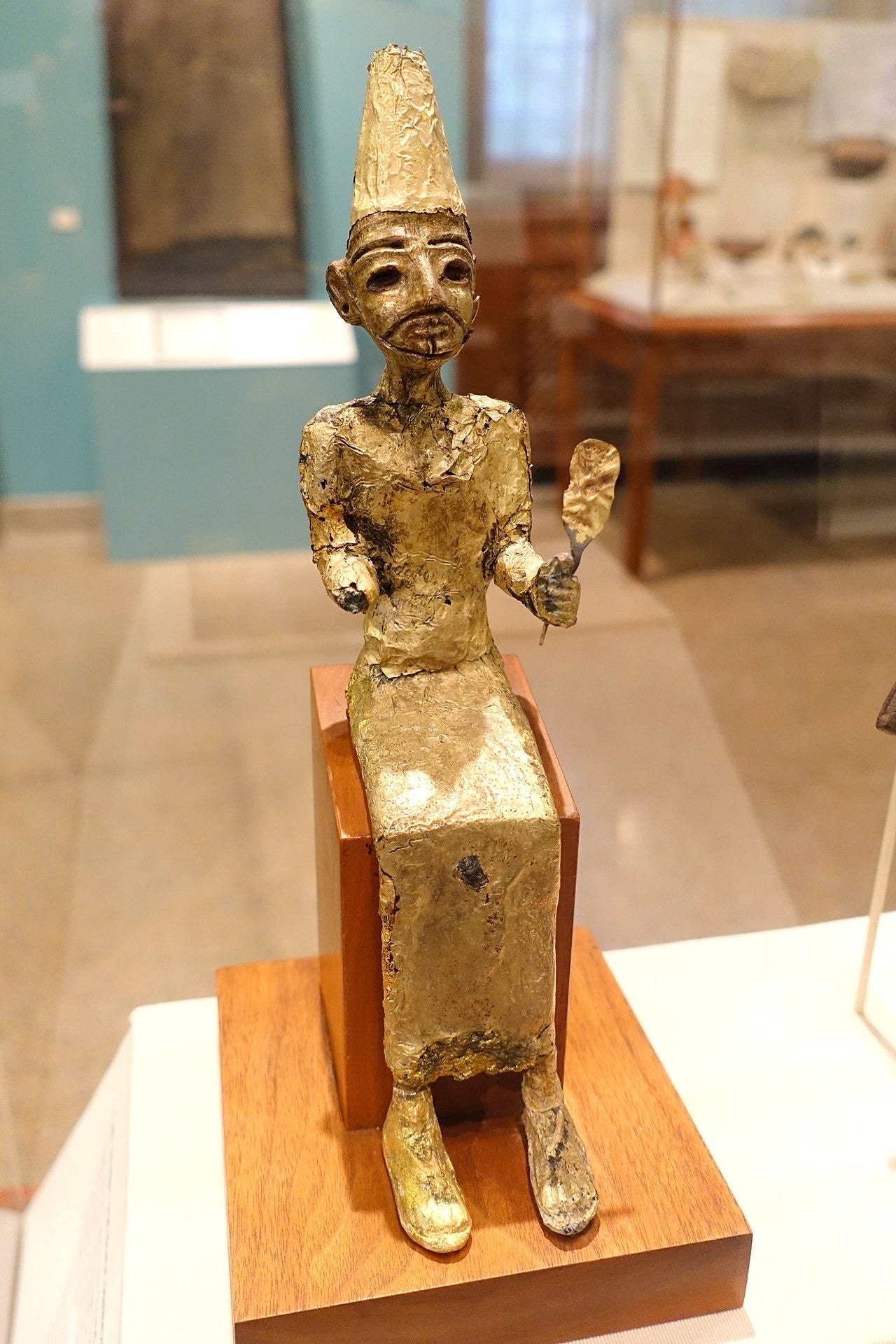
McClellan's claim runs underneath Halsall's. If Muhammad is the most important man in history, the prior question is what made a Muhammad, or a Jesus, possible at all. Without these four decisions there is no Islam and no Christianity, and the Israelite religion becomes one more regional cult that vanishes into antiquity.
Follow that out and the ground gives way under you. Remove those decisions and Rome's fall plays out into a different Europe, if Europe becomes a coherent idea at all. There is no Columbus; if that voyage happens at all it belongs to someone else, under a different flag, sailing from a different shore. The whole Western Hemisphere loses its history with him: no United States, no nation in North or South America with the trajectory it actually had, and the fate of the Aztec, the Inca, and hundreds of Indigenous nations turning on a contact whose timing, direction, and motive are all open questions. India has no Mughal Empire. Without Muhammad there is no Islam at all, and no Arab and Persian merchants settling Guangzhou and Quanzhou within a generation of his death. The entire western frontier of China, from Xinjiang through Lanzhou to the border with Kazakhstan, takes a different shape entirely, filled by whatever grows where Islam and the traders who carried it used to be. The European ships that reached East Asia five centuries later belonged to a Christian world with its own reasons to sail; without that world, nothing says they arrive at all. Colonization, the Industrial Revolution, and modern medicine don’t arrive arrive or belong to civilizations that in our world never rose. No civilization on earth comes through untouched. We have no real idea what the world would contain without Christianity, Judaism, and Islam. That is the measure of how much these four decisions uphold nearly the entire world and its history.
I read the Bible cover to cover at thirteen or fourteen, through the lens I had been given: two books, the first about a monotheistic god, the second about a new covenant with him, even though I could not have told you at the time what either of those words really meant.
Thirty years later, insomnia put me back in front of it. I started falling asleep to audiobooks, discovered Bart Ehrman, read his books, and kept digging into early Christian history until I had become something like an amateur historian of it.
I am still listening today. Some nights YouTube autoplays into lecture after lecture on the same handful of subjects, and last week I woke up to McClellan, mid-sentence, on those four decisions. Here is my attempt to put them together because if he’s correct about the importance, it’s something more people should also know.
What I had missed, reading as a believer at that age, is that the God of the Bible has an origin story of his own. He was not always the only god. He was not always the creator of the universe. He had a people, a territory, a mountain, and rivals, and the text occasionally lets that older world show through. Three passages do three different jobs. Exodus 6:3 marks an absence: the patriarchs knew God as El Shaddai, not by the name Yahweh. Deuteronomy 32:8-9, in the version preserved by the Dead Sea Scrolls, places Yahweh among the sons of El and gives him Israel as his own allotted portion, one god inside a larger pantheon and not yet at its head. The Song of Deborah, among the oldest poems in the collection, marks his origin, opening with Yahweh marching up from a mountain in the south like a storm god coming to fight, not descending from a settled heaven the way later theology assumes.
The theology that now organizes the religious lives of more than half the world did not come from any power that ran the ancient world. It came from a strip of hill country a few dozen miles wide, held by a people usually on the losing end of every encounter that mattered, conquered and deported again and again, a vassal or a casualty of whoever held Egypt or Mesopotamia. The Babylonian exile was meant to erase a people and its god, the way it had already erased dozens of others whose names survive only in someone else's victory inscriptions. Evolution happens under selective pressure and the scribes and priests who reworked the tradition in captivity walked out of Babylon carrying a God larger than the one who went in: universal, invisible, portable, already carrying the seed of what would become the God of roughly two billion Christians and nearly two billion Muslims. Its God outlasted the gods of every empire that conquered it. Twelve centuries after a Babylonian exile meant to erase them, a process began wherein nearly everyone in Mesopotamia would be worshiping the God of those defeated Judeans.
What follows is my own synthesis of the scholarship behind each of those four claims, built from archaeology, textual criticism, and comparative religion, with many details still disputed. I use "decision" as shorthand for long, overlapping processes rather than discrete moments of choice; the third and fourth in particular overlap in time, so the order below is conceptual as much as chronological.
A quick map before diving in. Decision One is about the god: the Canaanite pantheon Yahweh emerged from and his gradual merger with the older high god El. Decision Two is about the law: Josiah's reform, the scroll that authorized it, and the writing technology that made such a law possible. Decision Three is about the story: the account that keeps old gods from returning, whether the rival is a cult at home or an empire's god abroad. Decision Four is about the practice: exile turns law and story into Sabbath, diet, circumcision, and recitation, habits strong enough to survive without land, Temple, or state. A final section traces what happened once Persian rule and Greek philosophy got hold of all four, ending with the world Jesus was born into.
Decision One: The Conflation of Yahweh and El
The God
Decision One gives the eventual God his basic shape. Two separate gods, a storm-and-war deity named Yahweh and an older high god named El, merge into one. The process unfolds across centuries, consolidates after the northern kingdom falls in 722 BCE and Judah alone is left holding the story, and is essentially complete by Babylon's destruction of Jerusalem in 586 BCE. To see why the merger mattered, you have to meet both gods on their own terms, inside the world they came out of.
That world was crowded with heavyweights: the Hittites in Anatolia, Assyria and Babylon in Mesopotamia, Egypt along the Nile, Crete and Mycenaean Greece across the sea. Their contests centered on the Levantine coast and the corridor running from Egypt through Canaan toward Anatolia and Mesopotamia. Israel's heartland lay inland, in the highlands. Across the whole span this essay covers, from Egyptian rule in the Late Bronze Age to Rome, that strip of hill country lived almost entirely under someone else's control: Egypt, Assyria, Babylon, Persia, the Greek successor kingdoms, then Rome. The exception was the Hasmonean kingdom, which grew out of the Maccabean revolt and lasted roughly a century before Rome crushed it.
Gods in this world belonged to peoples, territories, cities, temples, priesthoods, cult objects, and armies. The norm at the time was to conquer a city, burn its shrine, seize its vessels, or carry its god home as a trophy. The Neo-Assyrian Empire introduced a practice of kidnapping the elite of anyone who resisted and resettling them far from home to break their culture and prevent revolt, which becomes central to this story. That is the background to every disaster that follows. When Assyria destroyed Samaria, or Babylon destroyed Jerusalem, the military question and the theological question arrived together, and every society in the region knew how that story usually ended.
The religion Jesus inherits will eventually present itself as the inheritance of creation itself: a law given at Sinai, a people chosen before the nations, a god who made everything. Its history begins in a much smaller place, with hill country caught between empires and a god who had a territory, a people, a mountain, and rivals.
The Canaanite Matrix
Before Israel had a name, before a single line of Hebrew was written, the land between the Jordan and the sea was already crowded with gods. The people who lived there, Canaanites, as we call them, were a patchwork of city-states and local cultures: Byblos, Tyre, Sidon (all on the coast of modern-day Lebanon), Hazor, Megiddo, Jerusalem in the hills (in modern-day Israel/Palestine). To the north, on the Syrian coast near the Turkish border, stood Ugarit, a cosmopolitan port whose archives would become the Rosetta Stone of the Hebrew Bible.
For a modern reader, the nearest familiar reference point is the world of the Odyssey: a crowded heaven, gods with families and grudges, cities under divine protection, storms and sea monsters carrying personalities, kings whose victories say something about the favor of heaven. Homer came later. The Greek gods are their own people, and the same crowded divine atmosphere animated both worlds. The war Homer sang about rests on a real destruction. Archaeologists call the layer at Hisarlik Troy VIIa. It was likely destroyed around 1200 BCE, in the same violent decades that ended Ugarit and the wider Bronze Age world.
Ugarit was destroyed in that same wave. The fire that burned the city baked its clay tablets as hard as pottery, which is why thousands of them survived intact for over three thousand years. From the rubble came the divine family that shapes everything after. When archaeologists unearthed those tablets in the 1920s, they became a Rosetta Stone for the Hebrew Bible, unlocking a shared religious grammar that had been hiding in plain sight. Ugarit was one city in a larger religious world. Tyre, Sidon, Hazor, Megiddo, Jerusalem, and the smaller highland settlements each had their own cults, sacred places, and their own arrangements of inherited gods. The names, stories, titles, and family structures preserved in the Ugaritic tablets reveal the grammar shared across the whole region.
But the gods those tablets describe were already ancient when Ugarit's scribes wrote them down. This is the chronological fact that makes the whole merger possible, and its scale is hard to internalize. El appears at the head of god-lists in the royal archive at Ebla (in modern-day Syria, about 50 km southwest of Aleppo) around 2500 to 2300 BCE—more than a thousand years before the Ugaritic texts, and well over a thousand years before Yahweh's name surfaces in any external inscription. The storm-god function Baal eventually claims is anchored in the same mid-third-millennium archives under the name Hadad, making it roughly as old. By the time Yahweh enters the historical record, as the "Shasu of Yhw" in an Egyptian inscription from around 1350 BCE, El and the storm-god tradition Baal carried were already more ancient to his first worshippers than Rome is to us.
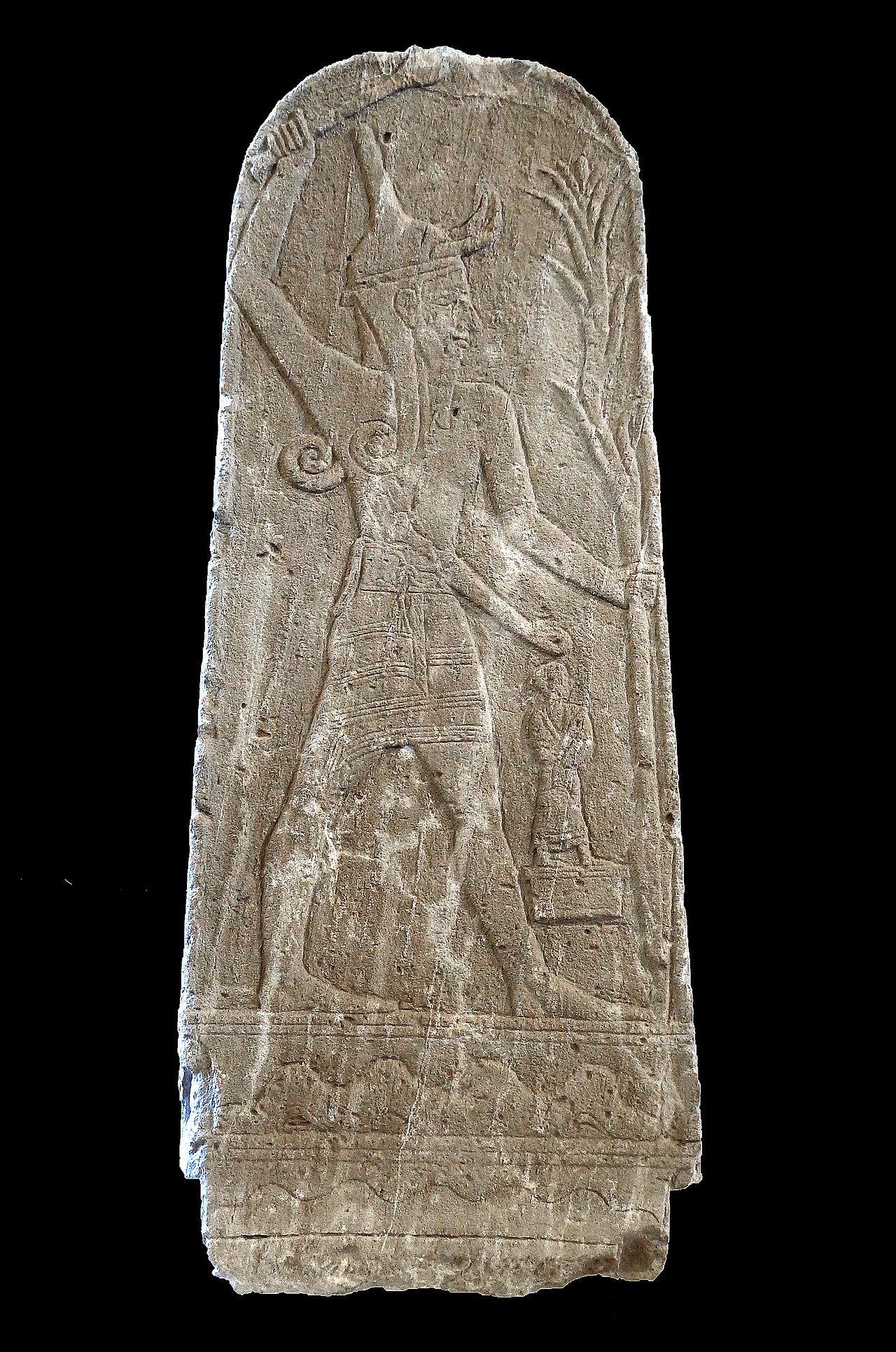
This is polytheism in its ordinary ancient form: a full divine family, ranked and related, none of them claiming to be the only one. At the head stands El, the high god, Father of Humanity, the Bull, old and wise and compassionate. He lives in a tent on the cosmic mountain at the source of the two rivers, presiding over the divine council. His consort is Athirat, Lady of the Sea, mother of the gods, associated with the tree of life. Together they have seventy sons, the divine beings who rule the nations of the world. Baal is the storm god, the rider of the clouds, voice like thunder and lightning for a weapon, young and aggressive, the warrior who defeats chaos and secures fertility—the younger upstart fighting his way into the established order. The central Ugaritic myth, the Baal Cycle, has him fight Yamm, the sea god and the chaotic waters, drive back the flood, and win a palace on the cosmic mountain. Yamm's monstrous servant is Lotan, the seven-headed twisting serpent, a name that will echo through three millennia as Leviathan. Mot is the god of death, sterility, drought.
In the standard arrangement, no one mistook a national patron for the high god. Chemosh was not El. Milkom was not El. They were junior members of the council, each assigned a people. Israel's innovation - the move with no real precedent - was to collapse that distinction. Yahweh, a storm-and-war god from the southern wilderness, was not just Israel's allotted patron. He was El, the ancient creator enthroned above the cosmos. The god of a small hill country and the god of the universe became the same being. That identification was not a natural evolution. It was a theological break with the entire logic of the world around it, and it is the founding move that makes every subsequent decision in this essay possible.
The Canaanite world did not disappear when Israel appeared. Its symbolic furniture was simply rearranged. The Sea became an enemy Yahweh defeated at creation and at the Exodus, its old name still flickering under the surface of Psalm 74, Isaiah 51, and Job. The divine council persisted in Psalm 82, 1 Kings 22, Isaiah 6, and Daniel. Angels are, in large part, what became of the old divine bureaucracy after monotheism won. Zion inherited the cosmic mountain; Jerusalem became Yahweh's mountain-palace; Solomon's Temple was a garden-palace guarded by monsters.
The old religion survives mainly in words for a second reason. It left physical objects: golden calves, Asherah poles, household idols, all attested in the Bible's own account of what it was fighting against. Centralizing reformers destroyed what they found. Josiah's purge, which Decision Two takes up, burned the Asherah in the Kidron Valley as declared policy, one instance in a long pattern of deliberate removal. The archaeological record reflects an erasure campaign as much as any original absence of objects. One shrine escaped it by accident: at Tel Arad, a Judahite fortress shrine near the empire's southern edge, two limestone altars held burnt cannabis resin mixed with animal dung on one side and frankincense mixed with animal fat on the other, a pairing published in 2020 that gives worship at an eighth-century Yahweh shrine a texture no purged site could leave behind. Poetry could hide inside a text the reformers still needed. A carved image had nowhere to hide.
The Rise of Yahweh
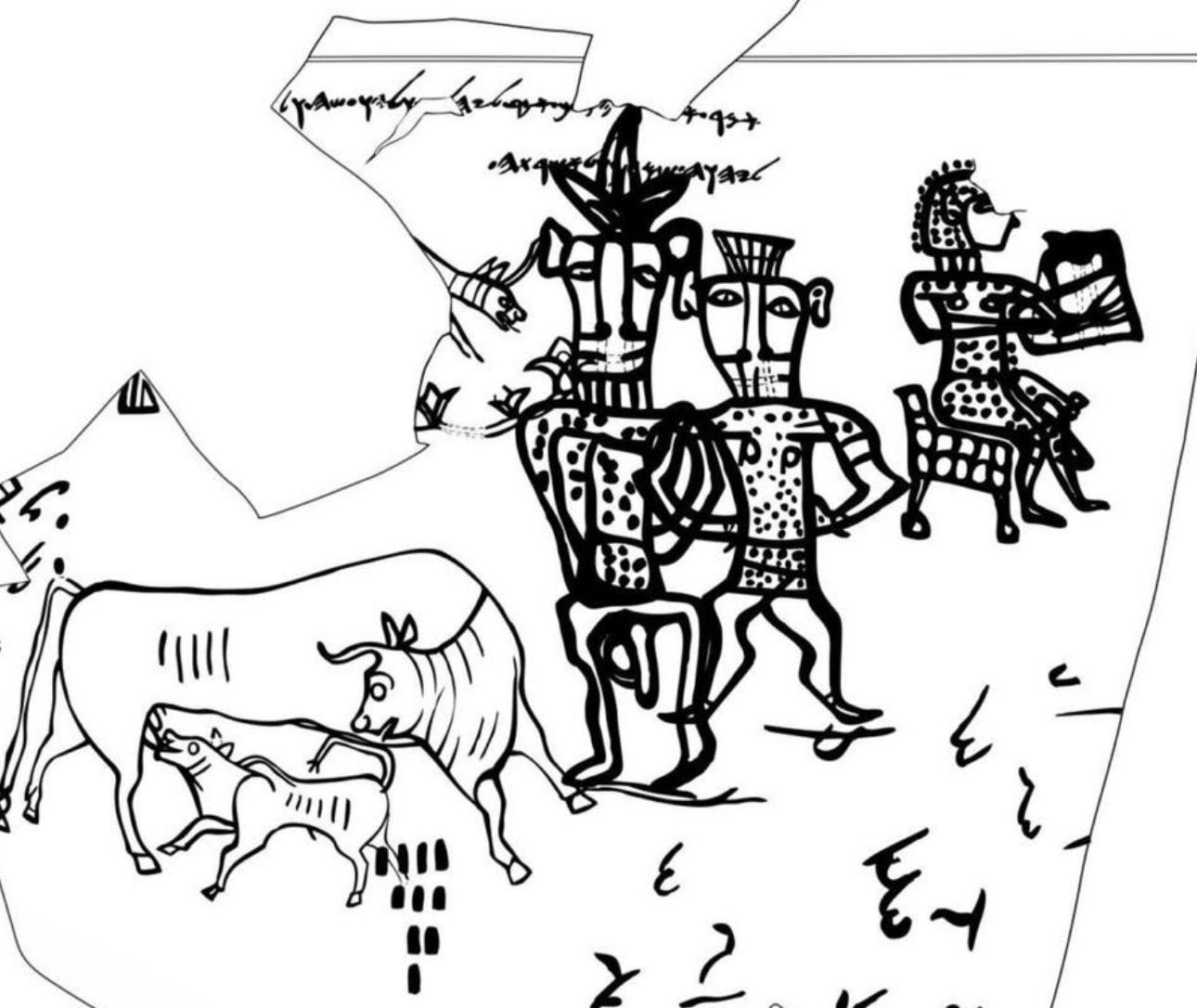
Several early biblical traditions place Yahweh's earliest remembered appearances in the southern wilderness, around Seir, Edom, Teman, Paran, and Sinai. The dominant hypothesis, drawn from the Song of Deborah (ca. 1200–1000 BCE), one of the Bible's oldest surviving poems, places his emergence right at the Bronze Age collapse. The poem cries out: "Yahweh, when you went out from Seir, when you marched from the land of Edom, the earth trembled, the heavens poured, the mountains quaked before Yahweh, the One of Sinai." The god it depicts is a warrior of storm and fire, arriving from a specific mountain region in what is now Jordan to fight for his people.
A second hypothesis reaches further back, into the Late Bronze Age (ca. 1400–1200 BCE), and argues that Yahweh began as an Iron Age cult, a god of metallurgy worshipped by the metalworkers of Edom and Midian. The hypothesis is still contested, but the logic is straightforward. Egypt's grip on Canaan collapsed and a power vacuum opened in the highlands. And there was a new weapon in town. Bronze couldn't be made anymore. The palace trade networks that had supplied tin and copper had fallen apart, and iron, which could be smelted from common ores, was suddenly the only path forward. The technology democratized warfare. Effective weapons were now available to anyone with a forge. The villages that would become Israel were newly freed and beginning to fight, but they were not yet winning. The biblical record describes the Philistines controlling iron production and keeping the Israelites deliberately disarmed. A people who needed a weapon they could not yet mass-produce deified the forge. The volcanic imagery, the fire, the smoking mountain, the lethal radiance all read like the marks of a smelting god, the kind of power that presides over the dangerous transformation of stone into metal. The very thing they were struggling to obtain was already sacred.
Over the next few centuries, Yahweh absorbed something larger than a storm and war god's profile. This original Yahweh was not yet the Creator. One major scholarly reconstruction of the older form of Deuteronomy 32 places him among the sons of El, with Israel as his allotted people. Here we reach a way of thinking about gods profoundly different from the modern one. Gods were tied to peoples, territories, and kinship networks. You did not so much choose your god; your god was part of your collective identity. El, the Most High, divided the nations among his divine sons, and each people received its own patron. An archaic poem buried inside Deuteronomy preserves the arrangement:
When the Most High gave the nations their inheritance, when he divided all mankind, he fixed the borders of the peoples according to the number of the sons of El. But Yahweh's portion is his people, Jacob his allotted inheritance.
Yahweh is not at the top yet. He is one god inside a larger divine order, Israel's national patron, assigned Jacob the way Chemosh belongs to Moab or Milkom to Ammon. The later Masoretic text, the standardized medieval Hebrew version most Bibles still translate from, reads "sons of Israel," but that version makes much less sense of the poem's cosmology. Many scholars regard it as a later smoothing of an older, more polytheistic reading, and the variant matters because the Hebrew Bible was otherwise transmitted with remarkable care. A difference this consequential is likelier to mark a real theological pressure point than casual noise.
The earliest Israelites were a loose confederation, not a kingdom. They carried a mobile throne, the Ark, into battle. They met Yahweh in fire and in a mysterious Angel who spoke in the first person as God and carried the divine Name. And then there is Asherah. In at least some Israelite and Judean settings, Yahweh appears to have had a wife. The inscriptions from Kuntillet Ajrud and Khirbet el-Qom bless people "by Yahweh and his Asherah." The most natural reading is that Asherah was a goddess, Yahweh's consort, exactly as she had been El's consort in the older pantheon, though scholars still argue over whether every use of the term names a goddess rather than a cultic object.
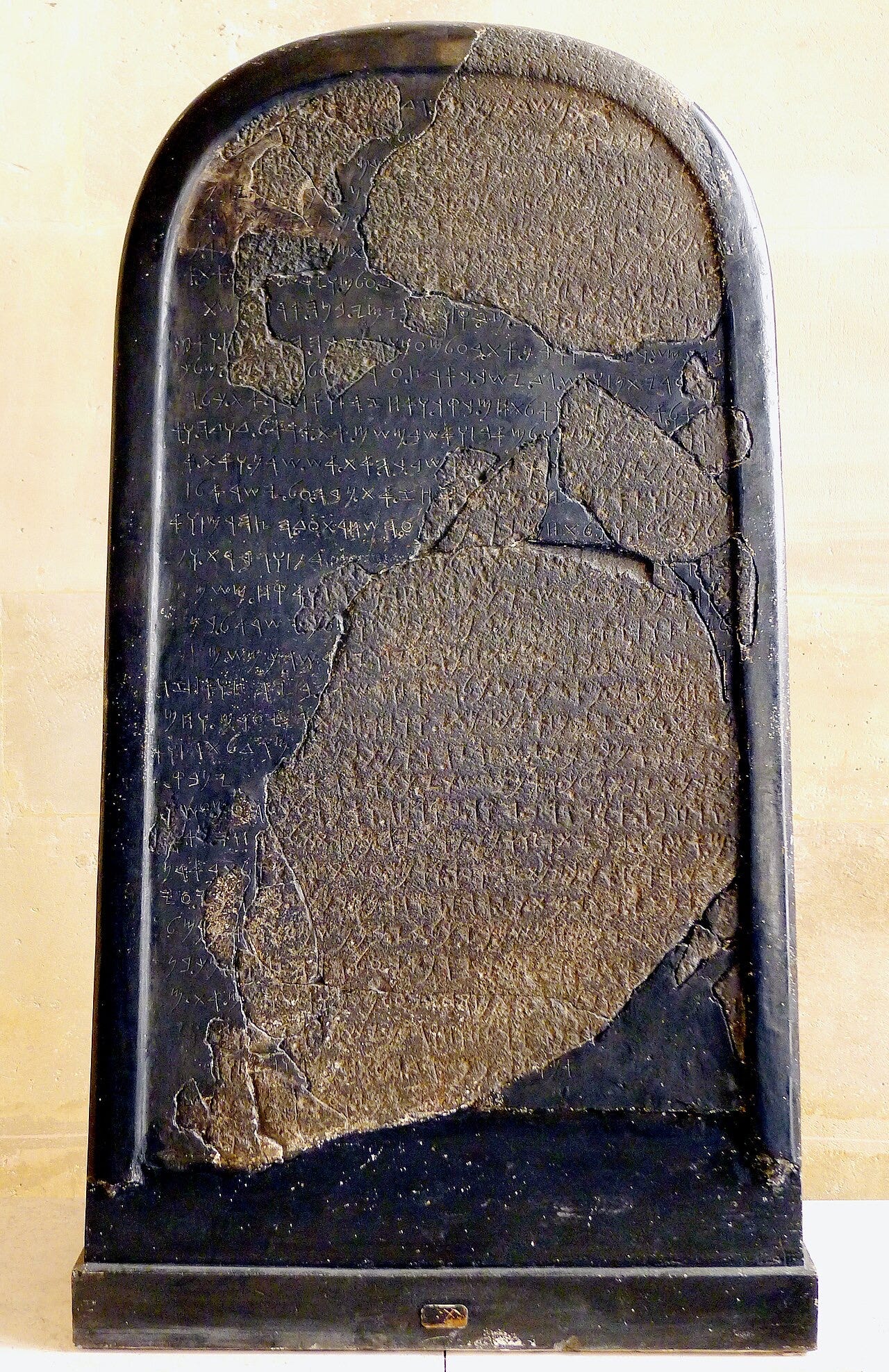
Yahweh could also be defeated in the rhetoric of his enemies. Around 840 BCE, King Mesha of Moab erected the Mesha Stele, one of the earliest substantial connected Northwest Semitic inscriptions to survive, and the earliest certain reference to Yahweh outside the Bible. It has a Moabite king reading his own military victory through the power of Chemosh and describes the capture of Yahweh's cult vessels. The Merneptah Stele had already named Israel for the first time, in an Egyptian boast that Israel was destroyed. The people and their god both make their first appearance in the external record as the vanquished.
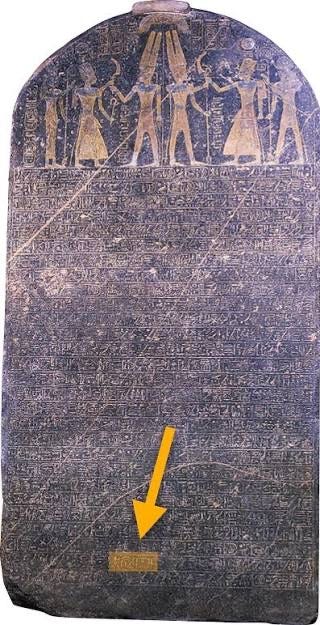
Then Assyria obliterated the northern kingdom in 722 BCE, and that catastrophe is what makes everything after it possible. Samaria fell. The northern court, shrine network, priesthoods, archives, and high culture were shattered as an independent system through deportation. Some traditions moved south with refugees, and Judean scribes absorbed and reworked them under Jerusalem's own agenda. With the north's institutions gone, Judah held the only surviving custody of the shared Israelite tradition, which is what turns the Yahweh-El merger from one regional reading among several into the only version anyone was left to write down.
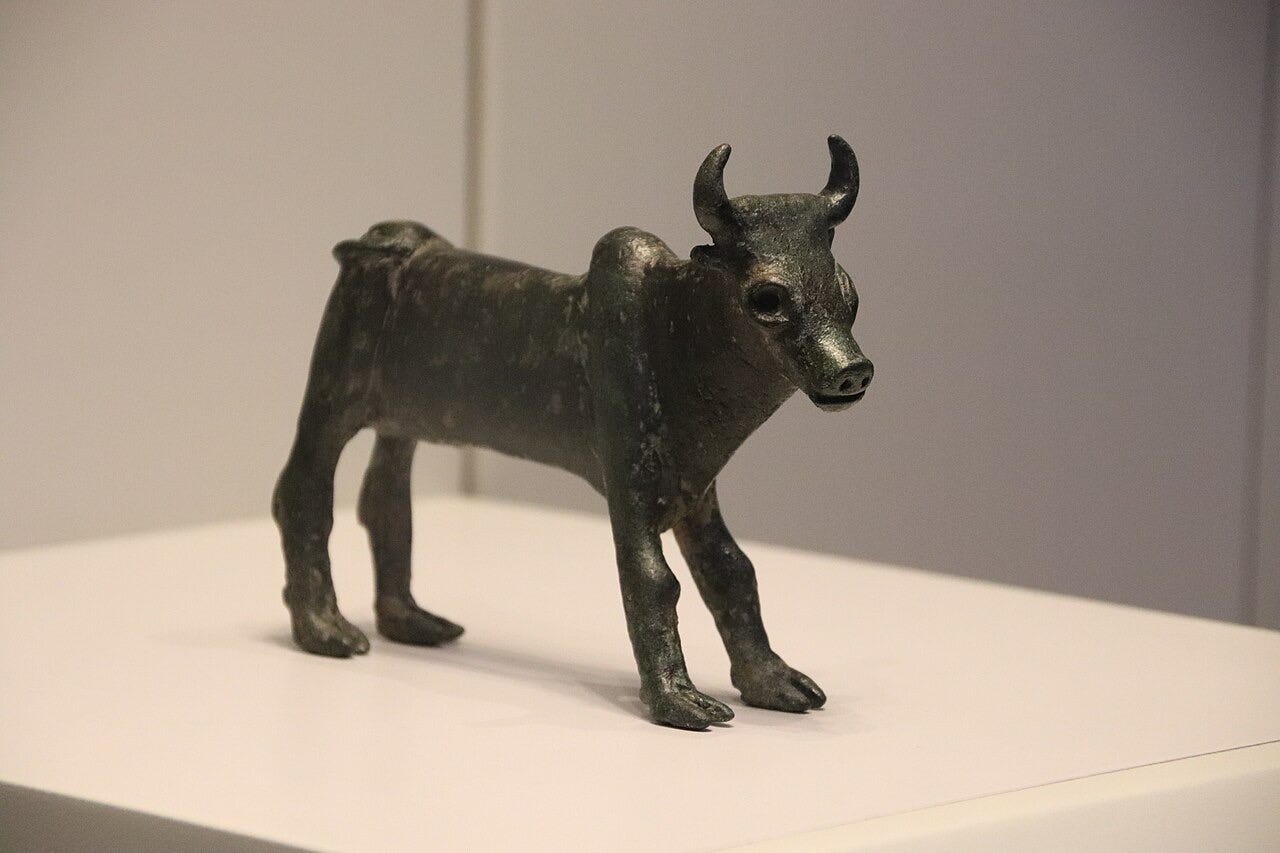
By then the merger was well underway. Across generations the southern scribes folded El's titles fully into Yahweh: Creator of heaven and earth, Father of the divine council, ancient patriarch enthroned above the cosmos, now carried by the same god who had marched from Seir and crushed the sea monsters. The old symbolic language came with the titles, including El's identity as the Bull, an image tied to divine power, fertility, and kingship, worth remembering because it resurfaces later in a story that reads at first like a betrayal of everything Yahweh stood for. One god now did the work that had once required two, and that included the violence.
The god who emerges from Decision One is both the calm architect of the universe and an unpredictable warrior capable of extraordinary violence. Both remain fully present in the text. The Yahweh who speaks creation into being in Genesis also commands, in Deuteronomy and Joshua, the total destruction of entire cities, men, women, and children included, language that reads as straightforwardly genocidal by any modern standard. The merger gave a patient creator and a jealous, wrathful warrior the same name, and both stayed on the page.
Decision Two: The Cultic Centralization Under King Josiah
The Law
Decision One fused a storm-warrior and an old creator under a single name. Turning that synthesis into something a kingdom could enforce required a different kind of work. The political landscape had shifted. The Assyrian empire, which had deported the northern elite and turned Israel into a province, was collapsing. As it withdrew, a power vacuum opened in the highlands. Josiah, a young king in Jerusalem, moved into the space Assyria left behind. The kingdom of Israel at its height had covered roughly 20,000 square kilometers. Judah, the southern rump Josiah inherited, was perhaps a third of that. He was no Alexander. He controlled a strip of hill country a few dozen kilometers across. But the vacuum was real, and he filled it. For a brief window, he held territory that had once belonged to the north and claimed the mantle of a united Israel under a single God, a single law, and a single sanctuary.

The reform ran on fear as much as ambition. The northern kingdom had been destroyed. Its people were scattered. Whatever the north had been doing, worshipping at its high places with their golden calves and Asherah poles, had not saved it. Josiah's answer to that fear was a diagnosis: idolatry had brought ruin, and only the exclusive worship of Yahweh at a single sanctuary could prevent Judah from following the same path. The purge was also political theater. By destroying the northern shrines, Josiah was claiming to restore a pure, original Israelite religion with Jerusalem at its center. The reform had to become the law of the land, backed by force, and it needed a technology that, by Josiah's time, was finally mature enough to carry the weight: the alphabet.
Writing already existed, but it was heavy. Egypt had hieroglyphs, Mesopotamia had cuneiform. Then, somewhere in the Egyptian-Canaanite contact zone, Semitic-speaking workers made an astonishing leap. They took Egyptian signs and stripped them down to sound. A picture of an ox became aleph. A house became bet. Water became mem. A few dozen signs could record speech, and the Phoenicians made the alphabet global. But that lower barrier still took time to produce storytelling. The proto-Canaanite script remained confined to a small region, the Shephelah, from the thirteenth to the mid-tenth century BCE. Only between roughly 880 and 830 BCE did it spread more broadly and differentiate into a recognizable Hebrew variant. Sustained narrative prose in an alphabetic script does not appear to survive anywhere in the Levant until the middle decades of the ninth century, and the earliest example in hand is the Mesha Stele, around 840 to 830 BCE. Before that boundary, epic poetry was the main technology for preserving long historical memory. The oldest layers of the Hebrew Bible survive as poems preserved like an insect in amber inside later prose. The seam sometimes sits inside a single book: Judges 4 tells the story of Deborah and Barak in standard, later narrative prose, and Judges 5 immediately follows it with the archaic poem itself, stratigraphy in miniature.
Writing material shaped what could survive. Clay endures, papyrus and parchment decay, and almost none of the original manuscripts behind the Hebrew Bible made it through antiquity. What we have instead are copies of copies, the oldest complete ones a thousand years or more removed from the events they describe. The one major exception is the Dead Sea Scrolls, preserved only because the caves above the Dead Sea sit in one of the driest places on earth.
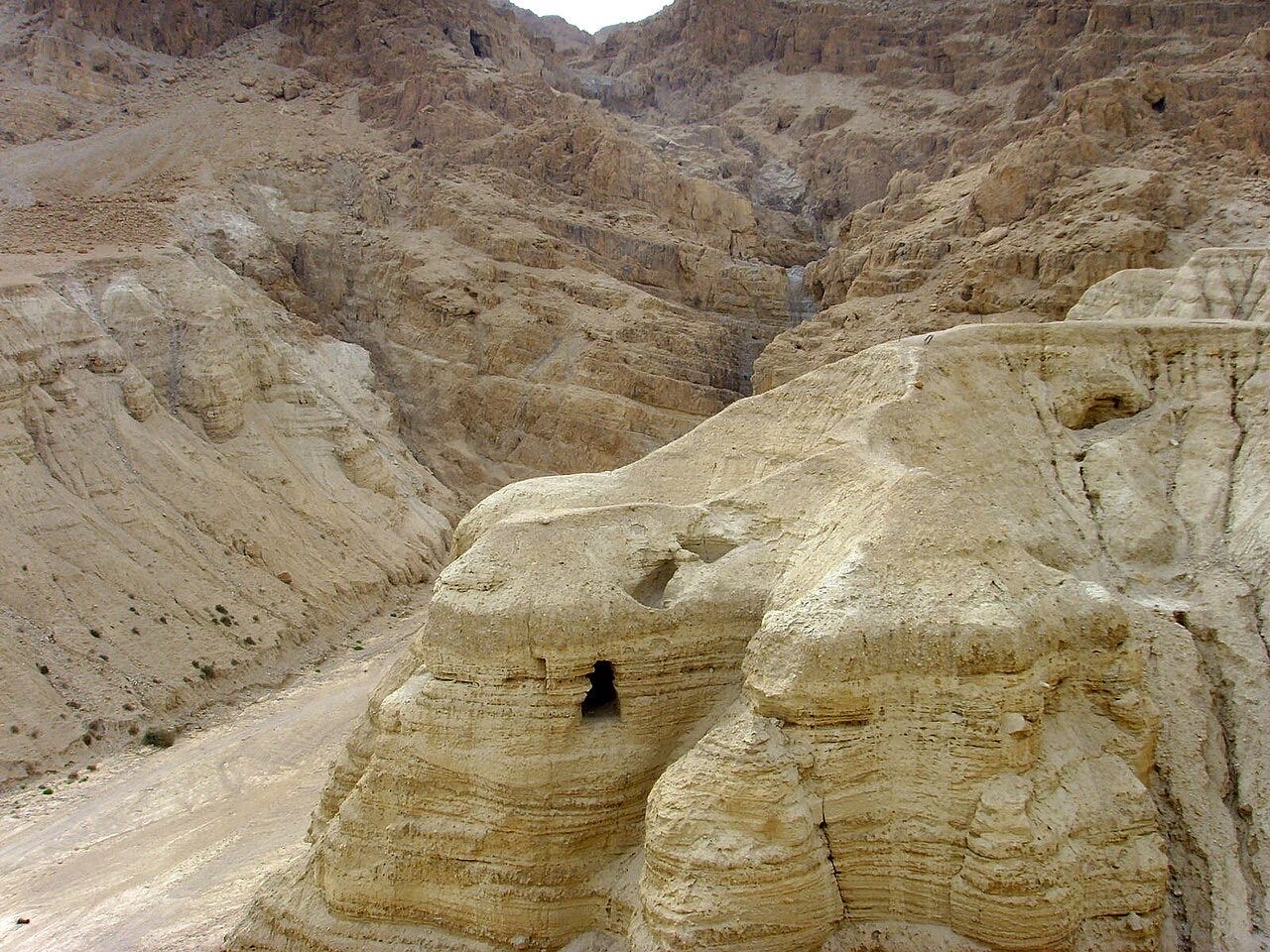
By Josiah's time, alphabetic writing was old enough to carry something larger than a victory inscription: a law, a past, and an argument about who had the right to speak for God. Even the covenant at Sinai borrows its shape from statecraft. A great king introduces himself, recounts what he has done for his vassal, lists binding obligations, deposits the document publicly, and closes with blessings for loyalty and curses for breach. That is the form of Neo-Assyrian vassal treaties, and Deuteronomy mirrors it with uncomfortable specificity. Its structure closely tracks the Vassal Treaty of Esarhaddon, the Assyrian king whose loyalty oath demands obedience "with all your heart" and threatens curses for disloyalty, language Deuteronomy echoes almost verbatim. The imperial system that had destroyed the northern kingdom supplied the legal template for the covenant. Israel repurposed the language of political subjugation as the language of chosenness. This is Deuteronomy's literary form, and it belongs to the same document as the reform it justifies.
The reform itself was a campaign of organized destruction. The Deuteronomistic history, the sweeping biblical narrative running from Joshua through Kings, portrays Josiah as destroying shrines outside Jerusalem, desecrating altars, and declaring the Jerusalem Temple the sole legitimate place of worship. He goes further than demolition. Second Kings 23 has him executing the priests of the high places on their own altars. Idolatry was banned outright, backed by a death penalty. The program enforced monolatry through institutional violence, not yet the claim that Chemosh and Marduk did not exist, but a hard demand that Israel worship Yahweh and no one else, on pain of death. When Josiah tore the Asherah out of the Temple and burned it in the Kidron Valley, he was attacking a marriage that had been central to Israelite religion for centuries.
The reform's own origin story is worth pausing on. Second Kings 22 has it begin not with a vision or a new cult object but with a scroll, "the book of the law," discovered during Temple repairs and authenticated by the prophetess Huldah before Josiah acts on it. Centralization and textualization happen as the same event. The authority holding the reformed religion together is a document being read aloud, not an image being installed. Many scholars identify that scroll with an early form of Deuteronomy, which would make the book most insistent on Yahweh's exclusivity also the book whose own discovery story models how authority now works in this religion: found and read rather than housed and fed.
That program ran on the same contractual vision of the divine-human relationship the treaty form carries. God had obligations, and so did Israel. Deuteronomy built the explanation for defeat into the contract itself. Worship other gods, tolerate the wrong shrines, ignore the law, and Yahweh will hand the country over to someone stronger. That became the central reading of catastrophe. Israel had not been abandoned by a weak god. Israel had failed the god it already had. Defeat was deserved. The north had been destroyed because it had worshipped wrongly, and Judah would suffer the same fate for the same reason.
Not everyone bought in. Second Kings itself notes tension over the fate of the priests whose shrines Josiah destroyed. Some were executed. Others were barred from serving at the Jerusalem altar but allowed to eat unleavened bread among their brothers, demoted but not destroyed. The reform was a transfer of power and resources to the Jerusalem Temple elite, and it is impossible to separate the theology from the institutional self-interest. The priests who lost their local altars and their livelihood may have experienced centralization less as a spiritual purification and more as a hostile takeover.
One more element belongs here: the prohibition that would become a defining feature of the God this reform enforced. The old world was full of divine images. Every temple had its cult statue. The Jerusalem tradition increasingly rejected them. You shall not make a carved image. The aniconic impulse belongs with the rest of Josiah's program: the destruction of cult objects, the Temple monopoly, and textual authority replacing visible forms. Yahweh had no face or body to sculpt. Images and cultic objects persisted in Israelite and Judean life, so the prohibition describes an ideal that had to be fought for. As it hardened, the empty throne in the Holy of Holies became the template, and the word, Torah or Quran, filled the space images had occupied in other ancient temples.‧
Decision Three: The Universalization of Yahweh
The Story
Josiah's reform made exclusive worship law, punishable by death, and shifted authority from an object you house and feed to a text you read aloud. Law can close a shrine. The collapse of Jerusalem demanded a story that could keep old gods from returning and explain why the god who was supposed to protect the city had allowed it to burn. That story took shape in the kingdom's worst year.
In 586 BCE, Babylon destroyed Jerusalem and deported the elite. It had already taken people in 597 BCE, and it did not empty the land in either wave. The Temple was destroyed. The monarchy was gone. In the ancient Near East, geopolitics and theology were mirror images of one another: if an empire breached your walls, looted your sanctuary, and absorbed your country, the result looked like a verdict delivered by the gods. Babylon seemed to have delivered exactly that. It destroyed Yahweh's city, burned his temple, carried off part of his people. Marduk, Babylon's great civic god, appeared to have won.
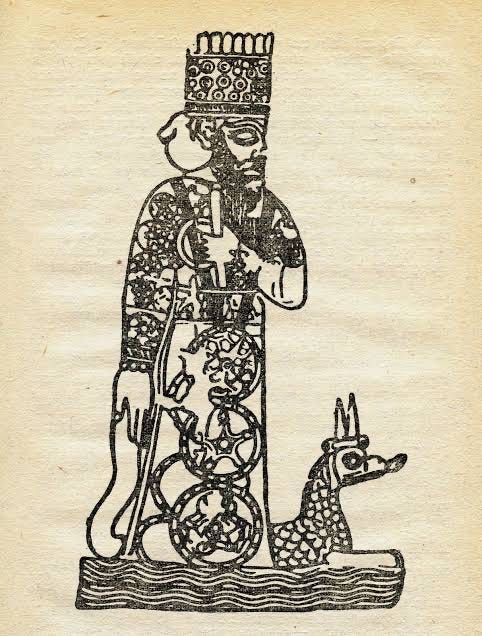
The exiles found a way to reverse the verdict. Babylon had not defeated Yahweh. Yahweh had used Babylon. The destruction was punishment, the deportation was discipline, the empire itself was an instrument in the hand of the god it appeared to have conquered. Once that move worked, Yahweh could no longer remain a god whose authority ended at Judah's borders. A god who commands Babylon rules Babylon. A god who rules Babylon rules the nations. Universal sovereignty became necessary.
The earliest form of the first commandment demands exclusive loyalty: Israel may have no other gods besides Yahweh. It is the language of a covenant between a god and his people, the same monolatry Josiah enforced with the sword. The exilic prophets take the final step, from monolatry to monotheism proper. In Isaiah, material composed during the exile, Yahweh declares that there is no other god, that none existed before him and none will exist after him. The claim concerns what exists, not only whom Israel may worship.
Psalm 82 preserves the older structure in the act of breaking it: God rises in the divine council and judges the other gods. McClellan ties that scene directly to this transition. The rhetoric of Deutero-Isaiah pushes further still: the gods of the superpowers are no longer serious rivals, they are wood and metal, products of human hands, carved, carried, fed, and abandoned. Defeat could now become evidence of power. Babylon's victory no longer proved that Marduk had overcome Yahweh. It proved that Yahweh's rule reached even into Babylon.
That reversal took durable form as a story, and the scale drops from empires to households. The old pieces, thin Exodus traces and the covenant's treaty form, were already there; this catastrophe, following Assyria's destruction of the north, gave them a fuller use. Scribes gathered poems, cult memories, laws, genealogies, and fragments of oral tradition into one continuous past: one family, one escape, one covenant, one law, one land, one God. This is ethnogenesis through story up close: a population deciding, after the fact, what kind of population it had always been.
What the Exodus Became
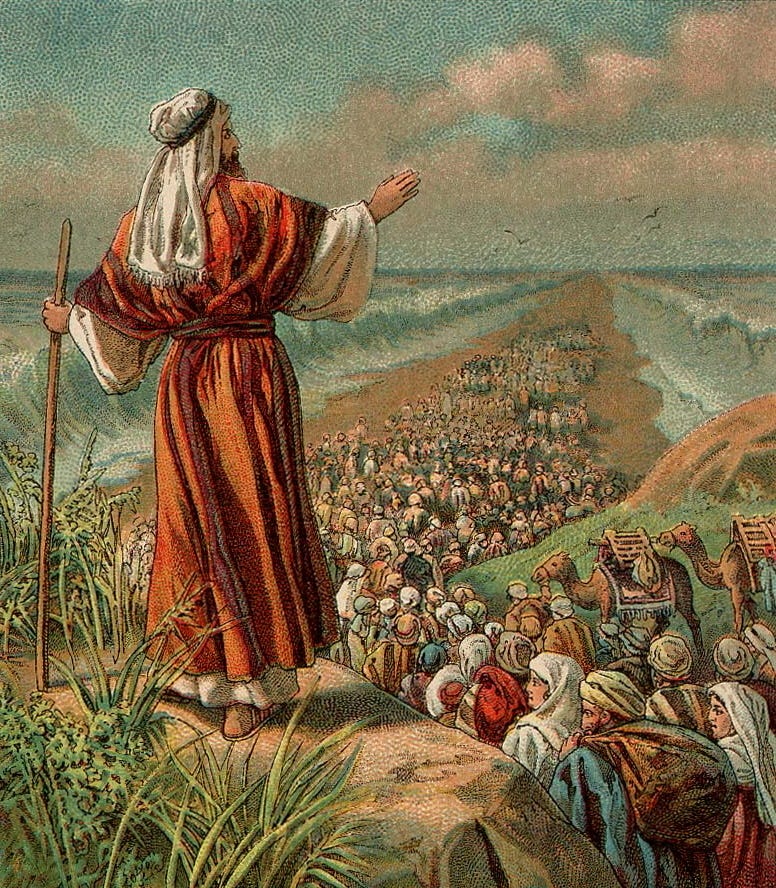
Here the recoverable event-history matters less than the shape of the story, which became the machinery later writers used to explain defeat and enforce religious loyalty. Archaeology has not corroborated the Exodus tradition at the scale or in the sequence the biblical narrative presents, and settlement evidence does not support a rapid, unified conquest under Joshua.
A historical memory may sit behind the story. Amos and Hosea, writing in the eighth century BCE, already know that Yahweh brought Israel out of Egypt. The better-evidenced reading grounds that memory in centuries of Egyptian domination over Canaan itself: subjugation on the land Israel already lived on rather than slavery inside Egypt's borders. Egypt ruled Canaan directly for roughly three centuries, from Thutmose III's campaigns around 1450 BCE until around 1150 BCE, when the Bronze Age collapse forced a retreat. Egypt itself did not fall; it was the one imperial survivor, but it pulled back from Canaan, leaving the highlands unsettled. That same chaotic window brought the Philistines to the coastal plain, and it is entirely plausible that a small group of slaves or refugees leaving a weakened Egypt during those decades carried, or encountered, Yahweh on the journey home. Fourteenth-century letters from Canaanite vassal kings to the Egyptian court, found at Amarna, describe tribute, garrisons, and a marginal underclass called Habiru or Apiru, displaced laborers living outside the palace economy; some scholars connect that term to "Hebrew." Israel's own emergence in the archaeological record, the Merneptah Stele placing it in Canaan by 1208 BCE, and the highland settlement boom that follows Egypt's retreat around 1150 BCE, all land squarely inside this window. The likelier reading is a population coming into its own identity precisely as centuries of Egyptian rule over its land gave way, its memory of subjugation later relocated, in the telling, from the land it had always lived on to the empire that had ruled it from afar. The finished version does something larger than record it: it turns local people into descendants of one family, ordinary settlement into conquest, and political weakness into the opening act of election.
The golden calf does the same delegitimizing work at a domestic scale. Moses goes up Sinai to receive the law, stays away too long, and Aaron makes a golden calf; Israel sacrifices before it, celebrates, and Moses comes down to find the people already breaking the covenant at the moment it is being made. The scene reads like the discovery of another god, and it is designed to read that way. But the calf is much closer to Yahweh than the story admits. In the northern kingdom, Jeroboam set up golden calves at Bethel and Dan and introduced them with the Exodus formula itself: "Here are your gods, O Israel, who brought you up from the land of Egypt." He was not announcing that Israel had abandoned Yahweh for Baal. He was claiming that this was Yahweh, the god of the Exodus, properly present and properly worshiped in the north. That claim makes sense only inside the older religious world Decision One laid out, where El, the high god Yahweh fused with, carried bull imagery, and Yahweh inherited it along with El's titles and authority.
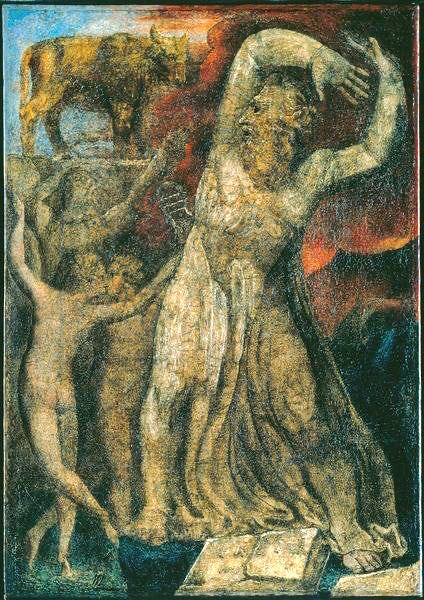
Exodus 32 therefore does something more aggressive than condemn a foreign cult. It reaches backward to an imagined Sinai, plants a rival form of Yahwism at the very origin of Israel's covenant, and makes it the first great act of national treachery. Aaron, ancestor of Jerusalem's priesthood, is made complicit. A northern cult that could plausibly claim antiquity, Exodus legitimacy, and continuity with older Israelite religion is rewritten as the pattern of everything that later went wrong. The story relocates the dispute into sacred time, gives one side the authority of Sinai, and leaves the other appearing to have been faithless from the beginning.
What the Firstborn Cost
The calf is the mild version of this move. The Canaanite package Israel inherited also carried practices that later readers find almost impossible to sit with, and the wildest of them responds to the same decoding. Child sacrifice was real in this world, and the evidence that Israel itself practiced it, not only the neighbors, sits inside the Bible's own text.
The blame is spread across three names, which is itself the tell. Leviticus and 2 Kings pin the practice on Molech, a god, or possibly a kind of offering: the Hebrew behind the name carries the root for "king," and one long-standing argument holds that a *mlk* was originally a type of sacrifice that biblical writers recast as a foreign deity so the deed could belong to someone else. Jeremiah pins it on Baal, condemning Judahites who built high places to burn their sons "which I did not command, nor did it come into my mind." Josiah's centralizing purge, back in Decision Two, makes a point of defiling the Topheth in the Valley of Hinnom precisely so no one can pass a son or daughter through the fire there again. That site was in Jerusalem, not in Tyre.
And then there is Yahweh. The firstborn law states the old claim without embarrassment: in Exodus 22, "the firstborn of your sons you shall give to me," set down in the same breath as the firstborn of oxen and sheep, with no ransom attached. Ezekiel 20 has God admit it more or less directly, saying he gave Israel statutes that were not good and let them defile themselves in offering up their firstborn, a line most historical-critical readers take as Ezekiel conceding that firstborn sacrifice had once been understood as a command from Yahweh rather than a corruption imported from abroad. Isaac bound on the altar and Jephthah's daughter are the same memory in narrative form. Yahweh had absorbed Baal's storm and war profile; he had also, it seems, once carried Baal's most terrible demand. Yahweh became Baal, and then Baal became the villain who did the thing Yahweh's own people had done.
Child sacrifice belongs to the logic anthropologists call costly signaling: an offering has to cost enough to signal something. Scripture even records the practice working. In the revolt of the same Mesha whose victory stele appears earlier in this essay, the king of Moab, losing a siege, sacrifices his firstborn son on the city wall; a great wrath falls on Israel, and the Israelites break off and go home. The Bible preserves an enemy's child sacrifice succeeding. Such a signal is reserved for the worst crises, which is exactly where the texts place it.
What happened to it afterward is the whole essay compressed into one law. Exodus 22 says give me the firstborn. Exodus 34 says redeem the firstborn, hand over an animal or a payment instead. That substitution runs on the same logic as everything else this religion does to its own inheritance. The bull stops being the god and becomes his mount. The cult statue becomes an empty throne. The image becomes a text. And the child becomes a ram. Sacrifice gets abstracted by the same ratchet that abstracts the god, and Isaac's ram, caught in the thicket at the last second, is that entire shift squeezed into a single scene.
Decision Four: Rallying Around Yahweh as Identity
The Practice
Decision Three turned a national patron into the only god there is and pulled scattered poems and memories into one continuous past a people could stand on. A universal god and a national epic still existed on scrolls. Someone had to live them without a country. That is the least finished of the four decisions.
Yahweh's universal sovereignty solved the theological problem of defeat. A displaced minority community still had to survive inside an empire. Documents from places such as Āl-Yahudu, literally Judah-town, show Judean families living and working inside the Babylonian imperial economy, often in rural settlements alongside other displaced populations. Their problem was practical: how does a people stay a people after losing king, Temple, land, and independence?
Judah had watched the northern kingdom lose exactly those things only a little more than a century earlier, in 722 BCE, its story surviving only insofar as it had been absorbed into someone else's. Assyria's deportations had broken the north's independent priesthood and scribal institutions, and no northern Torah survived as a northern tradition. Some scholars trace part of the Pentateuch's so-called E source, one of several older textual strands woven into the Torah, to that kingdom, arguing that northern material fled south with refugees and was absorbed into Judah's own text. If that reconstruction holds, it sharpens the pattern: what outlasted the northern kingdom did so by merging into a textual tradition someone else was still actively maintaining. Exile carried that recent precedent, the same god, the same region, the same imperial machinery, and the real possibility that Judah's own tradition might survive only as material folded into someone else's story.
The exilic community made devotion to Yahweh the non-negotiable core of survival. Sabbath, circumcision, dietary law, genealogy, Torah, and exclusive loyalty to Yahweh became a homeland you could carry. A calendar could mark the seventh day anywhere. Dietary rules turned ordinary meals into boundary markers. Circumcision marked the body, genealogies established continuity, Torah recitation turned memory into a household practice. None of it needed a king, a Temple, or control of territory.
Every one of these costs something: a day of lost labor each week, whole categories of food refused, a permanent cut in the flesh, marriages narrowed to the right lineage. The cost is what makes them work, the same costly-signaling logic that had once asked for the firstborn and now asked for smaller payments a family could make year after year. The old signal burned on a pyre in a crisis and belonged mostly to kings. The new ones ran every day, in every household, on the calendar, the plate, and the body, and each payment drew a line around who belonged. This is where the machinery of Judaism, then and now, comes from: costly signaling and boundary-making fused into a daily routine, imposed on the whole community rather than performed by a few Temple specialists. What the religion had once been willing to burn, it learned to spend.
What was changing went deeper than ritual. The very nature of religion was being rebuilt. The historian Guy Stroumsa has argued that late antiquity transformed ancient cult into something closer to what we now mean by "a religion." The old model was local and transactional: feed the god, maintain the temple, offer sacrifices on behalf of the king and the city, and the god protects you. It was civic, not personal. Correct performance mattered more than correct belief, because the altar does not ask you to interpret anything. A scroll does. Once the god became a text you read rather than a statue you fed, correct understanding started to compete with correct ritual. Performance remained necessary, but interior conviction—faith, belief—began to matter in a way it simply had not before. The four decisions this essay tracks are the engine of that transformation. The portable, text-bound, community-marking religion that emerged from exile did not just survive the loss of the Temple. It had already built a structure that could function without one. Sacrifice receded. A book became the fixed center. The community crystallized around shared internal markers rather than shared geography or a shared statue. Christianity and Islam inherited this shape directly. Both would push the turn toward belief further, especially Christianity, which made correct belief salvifically load-bearing. Islam's formulation stayed closer to Judaism's older model, orthopraxy and creed both mattering, neither swallowing the other whole. But both were poured into a mold that the exile had already fired.
The comparison that makes this decision legible is every neighboring tradition Assyria and Babylon had already dismantled. A regional god depended on a stationary apparatus, a temple, a cult statue, a priesthood tied to one city. Destroy the apparatus and the tradition usually died with it, or survived only as a name in someone else's victory inscription, the way Chemosh and Milkom do. What Judah carried into exile instead was a text, already invested with centralizing authority since Josiah's scroll, portable in a way no statue could be. Textuality alone was not enough, though. Babylon's own cuneiform religious literature kept being produced by priests for centuries after Persia conquered it, and its cult still faded, because cuneiform demanded years of specialist training and no exiled community carried it as a shared household practice. Judah's advantage was the combination: scribal networks, household recitation, and communal ritual carrying a tradition already treated as the seat of religious authority before the crisis hit, sustained by a community that now had every reason to keep reciting it, because reciting it was what made them a people at all.
Put together, the four decisions did more than save one religion. They built a particular kind of social technology: a god, a law, and a group identity fused into a written tradition that scribal networks and household practice could carry farther than any single sanctuary. Zoroastrianism offers a complicating comparison, since its own scripture stayed largely oral for centuries yet its literature kept being produced well after the Islamic conquests, and the reasons its community eventually contracted involve political and legal pressure at least as much as the medium of transmission.
The destruction of the northern kingdom also gave Jerusalem an opening to claim the role of Israel's last legitimate center. The claim was theological and political at once. The literature that came out of exile makes clear where the scribes wanted to go. Exile had been punishment. Return required repair: rebuilding the second Temple, restoring sacrifice, recovering the law, policing marriage and lineage, observing Sabbath, and rejecting foreign cults. Ezra and Nehemiah are not subtle about the tone.
None of this happened evenly. Elephantine, in southern Egypt, shows how much variation remained. In the fifth century BCE, while Jerusalem-centered scribes were consolidating the program that would eventually define Judaism, a Judean military community there kept its own temple to YHW and offered sacrifices outside Jerusalem.
The Pentateuch reached something close to its final form in this Persian-period world, broadly the fifth and fourth centuries BCE in the reconstruction many scholars now use, built from much older materials but consolidated into this container only now. By the time Alexander arrived in 332 BCE, the whole thing was old enough to feel primordial. It was historically young. "Final form" is doing some work in that sentence: the Samaritan community preserved its own version of the Pentateuch, and the Dead Sea Scrolls show real textual plurality persisting well into this period, so "final" means something closer to a dominant, stabilizing tradition than a single fixed text everyone had already agreed on.
The World the Four Decisions Made
By the Persian period, the four had converged: one god, one law, one story, one practice, fused into a written tradition light enough to carry and stubborn enough to reproduce itself anywhere. Persian rule and then Greek philosophy brought new questions to test what had been made. This section follows what those empires did to a god, a law, a story, and a practice already taking durable form.
Persia: Evil, Judgment, and the Cosmic Enemy
The Persian period deepened the problems exile had created. Cyrus took Babylon in 539 BCE, let exiled populations return and rebuild local cults, and brought Judeans into a new imperial world that would shape them for generations. The exact line between Zoroastrian and Jewish ideas remains disputed, and no surviving text lets us watch a Judean scribe copy Persian theology into a biblical manuscript. The conceptual pressure is still hard to miss. Persian religion offered a universe organized around truth and falsehood, order and destruction, good and evil, in which human choice mattered and history moved toward judgment rather than simply repeating itself forever.
The older biblical world had enemies, monsters, impurity, hostile nations, and foreign gods, without the fully developed moral universe later readers expect. Satan in Job is the accuser, a figure inside Yahweh's own court, dangerous the way a prosecutor is dangerous, far from the great enemy of God. The exact role of Persian contact remains hard to pin down. Across the same centuries Judeans lived inside an empire whose religion organized the world around a struggle between a good power and an evil one, the satan gradually became something closer to a cosmic rival.
A god abstracted into creator and ruler of everything raises the problem Zoroastrianism was built to answer: if one god controls everything, why does evil keep happening? The older composite Yahweh did not require that question in the same form. In Second Temple Judaism it remained a contested current, one strain among several. Its later Christian development belongs to Part Two.
In the centuries after exile, Jewish literature begins to fill up with named angels, demons, cosmic rebels, books of judgment, hostile powers, resurrection, final reckoning, and an approaching end of history. The result is dualism without two equal gods: evil becomes more organized, more dangerous, more cosmic, but it stays a rebellion inside a universe Yahweh still owns. The angels belong to the same transformation, a growing population of intermediaries standing between heaven and earth. A god who rules everything has to become less local, less bodily, less available for the old kind of direct encounter, and angels preserve distance without making him absent.
Greece: God and Metaphysics
There is a long way from a god coming out of the southern wilderness in fire and thunder to the God later monotheism will call the source of being itself. Alexander took the Levant in 332 BCE, roughly two centuries after Cyrus took Babylon. Greek rule entered a world where Yahweh had already become universal, the other gods had been subordinated or denied, Torah had become a portable constitution, and exile had made the problem of evil impossible to ignore.
Greek culture expanded the questions available to ask about God. The old biblical Yahweh spoke from a bush, descended on mountains, smelled sacrifices, got angry, regretted, and relented. Greek philosophy had spent centuries asking what the highest reality could be if it were perfect: whether it could change, suffer, have a body, move through time, or need anything. Plato, Aristotle, and the schools that followed supplied a vocabulary for an eternal, incorporeal, self-sufficient first principle. Jewish thinkers began interpreting Yahweh through that conceptual machinery. The more absolute he became, the more distance opened between him and the world, and that distance had to be managed. Wisdom, Word, angels, divine powers, and heavenly intermediaries kept God present without making him local again. By the time Philo of Alexandria was writing, roughly contemporary with Jesus, he could read Moses through Platonism and Stoicism and describe the Logos, God's Word or rational ordering principle, as the means through which the incomprehensible God creates, governs, reveals, and stays related to the material world. The God of Abraham had become the God of metaphysics as well.
The same shift changes creation itself. Genesis begins with darkness, waters, wind, and unformed matter, with God imposing order on chaos; its opening chapters likely reached final form only in the Persian period, though built from older material. The later doctrine that God creates everything from nothing belongs more clearly to the Second Temple and early Christian world, where creation becomes a test of absolute divine power.
The human being changes with him. Much of the Hebrew Bible imagines death as Sheol, a dark and diminished underworld where kings and slaves end up together, rather than immortal souls waiting to escape the body. During the Second Temple period, Jewish writers worked out rival answers to a question exile, empire, martyrdom, and universal monotheism had made impossible to ignore: what happens when the righteous suffer and die while the wicked prosper? Daniel, in its final form from the Maccabean crisis of 167 to 164 BCE, gives one answer: bodies waking from the dust. Other writers, especially in Greek-speaking Jewish circles, move closer to the immortality of the soul. The full architecture later familiar to Christians and Muslims, a soul that survives death by default and a final judgment sorting every life into one place or another, still lay centuries ahead.
Apocalyptic hope grew out of the same pressure and the same older logic. If defeat was punishment for failing the covenant, the reading Decision Two built into the religion, then a nation that finally kept the law well enough had a claim on God reversing course. Different groups pictured the reversal differently. Some expected a political and military Messiah, an anointed king who would defeat Israel's enemies the way David supposedly had. Others expected something more cosmic, an act of God ending the present age outright. Both versions kept the same underlying math: national restoration tied to observance, running in a straight line back to Deuteronomy's own contract, worship rightly and prosper, worship wrongly and be conquered, now projected forward as a promise instead of backward as an explanation.
Rome: The World Jesus Inherited
Pompey took Jerusalem in 63 BCE, and by the time Jesus was born Judea had spent generations inside a Roman political order layered over Greek language, Greek philosophy, Persian imperial memories, Torah, Temple, diaspora communities, angels, demons, apocalyptic expectation, and sectarian conflict. Jesus was born into the result of all of it: an ancient mythology, a recently consolidated scriptural constitution, a universal God, a populated heaven, a coming judgment, and an empire occupying the land where the story said God had once brought his people home.
The foundation was fragile. The old sits beside the new with no seam marking the difference: an archaic war poem like the Song of Deborah a few sentences from priestly law finished half a millennium later, both presented as part of one continuous story. Sledge and McClellan kept landing on the same blunt conclusion: the Hebrew Bible preserves polytheistic divine-council language, demands for exclusive Yahweh worship, and explicit monotheistic claims from different periods and theological projects. It is a layered archive, assembled over time, rather than a monotheistic document in the modern sense from the start.
If God had become too transcendent to enter matter directly, what did it mean to say that God became flesh?
Take away any one of the four decisions and that question does not arise in the form history actually gives it. The world religion that eventually spread across continents began as a series of choices made by scribes, priests, refugees, and political authorities from a defeated strip of hill country. Part Two picks up with what happened when one man from that world was executed by Rome, and his followers concluded that he had risen from the dead.
Further Reading
Mark S. Smith, The Early History of God: founding academic case for Yahweh's El-Baal fusion.
Smith and Pitard, annotated Baal Cycle translation: lets you read the actual 14th-to-12th-century BCE source myth behind the "young upstart versus old creator" dynamic.
Theodore J. Lewis, The Origin and Character of God: comprehensive, debate-aware survey of El, Yahweh, and divine iconography together.
Amzallag, Yahweh and the Origins of Ancient Israel: strongest version of the metallurgy hypothesis, argued by someone with real archaeometallurgical training.
Levinson on Deuteronomy and the Vassal Treaty of Esarhaddon: shows the near-verbatim borrowing behind Decision Two's treaty-form argument.
Lauren Monroe, Josiah's Reform and the Dynamics of Defilement: reconstructs the composite textual layers behind the reform's questionable historicity.
Van der Toorn, Family Religion in Babylonia, Syria and Israel: grounds the exile's turn toward household practice in comparative Near Eastern context.
Stroumsa, The End of Sacrifice: traces the full late-antique shift from ritual-centered religion to belief and text that Decision Four leans on.
Fascinating, thank you. One aspect that needs clarification is the role of Zoroastrianism and Cosmic Dualism. As we know, Zoroastrianism centers on a cosmic struggle between Ahura Mazda representing good/light and Angra Mainyu/Ahriman representing evil/darkness. This influenced Jewish eschatology, helping to elevate Satan in later literature from a servant of God to a powerful, opposing cosmic force. Also, the hierarchy of named angels (like Michael and Gabriel) and demonic forces in later Jewish and Christian texts closely mirrors the Zoroastrian hierarchy of Amesha Spentas (beneficent immortals). We know that early Israelite traditions did not emphasize heaven, hell, or a final bodily resurrection. However, Zoroastrianism’s strong doctrines regarding the resurrection of the dead, individual judgment, and a renovated world heavily influenced Jewish apocalyptic texts. Finally, the Gnostics righteously stripped Yahweh of his supreme status and reframed him using the exact characteristics of Ahriman. Like Ahriman, the Demiurge, Yahweh, a cruel desert metalworkers' god invented by sociopaths, rules over a material prison of suffering, blindness, and death, keeping human souls trapped in darkness. Luckily for long suffering humans, a way to return to the original light was identified by wiser people than the Jews.